Napa Valley wedding venues,
through a filmmaker’s eyes.
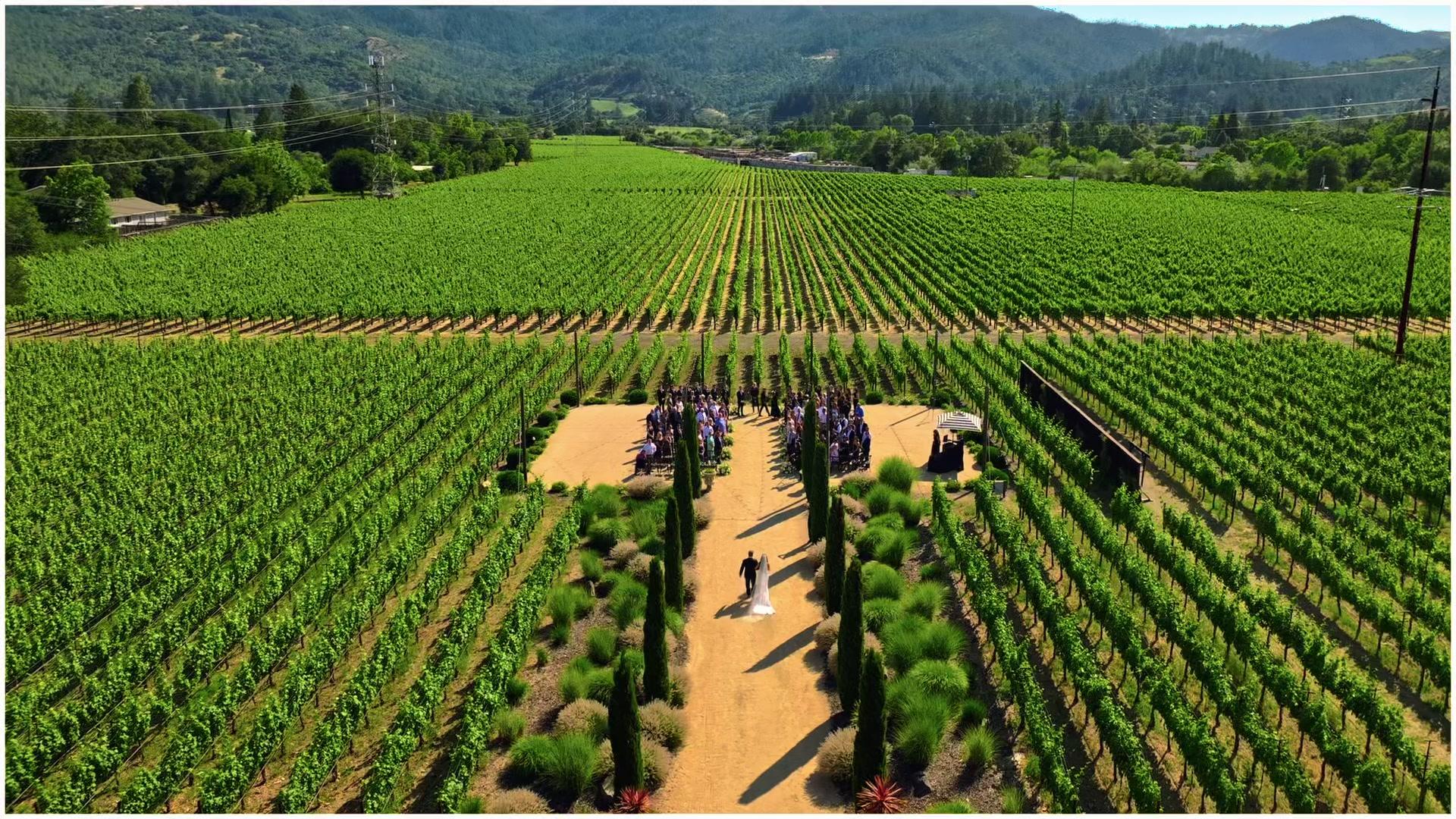
A wedding film is shaped by three things the venue decides long before we arrive: the light, the sound and the hour. Two estates a few miles apart can give a couple very different films, one warm and low across the vines, the other flat and loud under a midday sun.
These are notes on Napa Valley’s wedding venues as a filmmaker sees them: why so few wineries can host a wedding at all, when the light is at its best through the season, and what we notice at the places that can. Every fact about a place comes from the place itself or from a source listed at the end. The opinions are ours.
Why so few wineries can say yes.
Most couples arrive in Napa imagining vows among the barrels of a famous winery. Most of those wineries cannot legally host them. Under Napa County’s Winery Definition Ordinance, wineries in the agricultural zones may hold tours, tastings and the marketing of wine, as long as all of it stays secondary to making wine. The county treats a wedding as a commercial event, not the marketing of wine.
The exceptions are few, and each has a reason. A winery that held events before the county began requiring use permits in 1974 may continue with a certificate of legal nonconformity. A winery inside a city’s limits, like Beringer in St. Helena, sits outside the ordinance, and so do resorts with zoning of their own. Lists of the wineries that can say yes differ from source to source, but they run to only a handful.
In practice, a Napa wedding happens at a resort, at a hotel’s estate or at one of those few wineries. Before you fall for a winery, ask it plainly what allows it to host your wedding.
When the sun goes down.
Sunset in Napa moves by well over an hour across the wedding season. Approximate times for the valley, on daylight time:
- April: about 7:30 in the evening at the start of the month, close to 8:00 by its end.
- June: about 8:30, and the latest of the year by the end of the month.
- August: about 8:20 at the start, near 7:40 by the end.
- September: about 7:40 at the start, near 6:55 by the end.
- October: about 6:50 at the start, near 6:10 by the end.
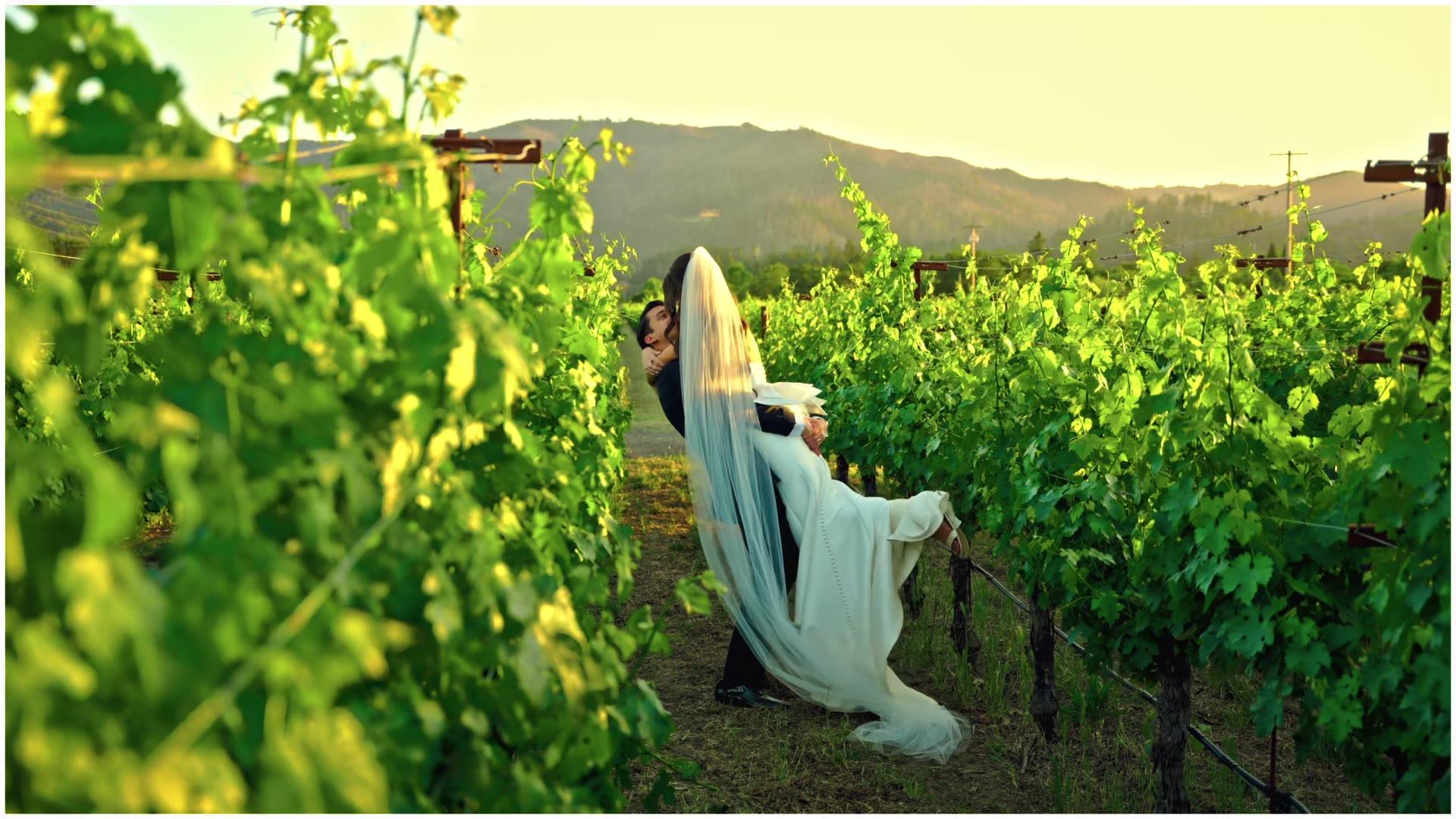
The light we hope for comes in the last hour before sunset, when it is low, warm and kind to skin, and in the half hour after, when the sky keeps a little color and the vines turn blue. Midday sun on the valley floor is the opposite: hard shadows under the eyes, squinting through the vows, heat on everyone in dark wool.
If we could ask one thing of a ceremony, it would be to begin about an hour and a half before sunset. The vows then fall in warm light, and the portraits after them in the best of it. Where hills rise to the west of a venue, the sun leaves the lawn before the time on the calendar, so ask the venue, or walk the site at that hour in the month of your wedding.
Heat, fog and harvest.
The valley grows warmer the farther north you go. July afternoons in Calistoga average close to 90°F; at the south end of the valley, near the bay, the average is nearer 79°F. A summer afternoon ceremony up-valley asks a great deal of a wedding party in wool.
Carneros, at the southern end, is cooled by San Pablo Bay. Its mornings are often wrapped in fog, and its afternoon breezes are, in the words of its own growers, cool and often quite strong. Fog makes a beautiful, soft morning. Wind is the enemy of the vows. We place small wireless microphones on the couple and the officiant for exactly this reason, but a sheltered ceremony site is still the better answer.
Harvest begins in August with the grapes for sparkling and white wines and runs through October, sometimes into November, for the reds. Picking often happens overnight, and September and October are the busiest months in the valley. For a film, harvest is a gift: heavy vines, bins of fruit, work at the edges of the day. For planning, it means booking rooms early and allowing time on the roads.
Calistoga and St. Helena.
Solage (opens in a new tab)
The Solstice Event Lawn holds up to 260 guests and, in summer, blooms with thousands of white roses, with views of the Palisades. A smaller lawn, the Estrella, looks toward the Mayacamas. The resort asks that every wedding have a professional planner.
Calistoga is the warmest corner of the valley, so the hour matters more here than anywhere. A ceremony timed to the falling sun is cooler, kinder to faces and better for the film.
Harvest Inn (opens in a new tab)
Lawns and terraces among gardens and vines: the Vin Rose Lawn beside the vineyard for up to 120, the Manor House Lawn framed by botanical gardens for up to 200, and a Vineyard View Terrace under wisteria.
There is also a Fountain Terrace, lovely for a small dinner. For the vows we would choose a lawn: moving water reads as noise beneath quiet words, while roses and wisteria give a film the texture we love.
Charles Krug (opens in a new tab)
The Great Lawn sits among heritage oaks and vineyards, large enough for a very large wedding. The Redwood Cellar, built in 1872 and renovated by Howard Backen, has high open-beamed ceilings and windows onto the barrel room; the Carriage House, from 1881, has a cathedral ceiling.
Old oaks are a filmmaker’s friend: dappled shade on a hot afternoon, and depth behind every frame. Inside, old wood and high ceilings hold warm light well into the evening.
Beringer (opens in a new tab)
By its own account the longest continuously operating winery in Napa, with the Rhine House, the Hudson House for weddings of up to 90, a Citrus Grove for up to 150 and a Redwood Grove for smaller dinners.
Groves are what we look for in the valley’s heat: shade that moves, and trunks and leaves that frame a couple without a backdrop built for the day.
Merryvale (opens in a new tab)
The Cask Room, for receptions of up to 112, is lined with century-old casks. Merryvale describes itself as the first winery built in Napa after Prohibition.
Rooms like this are made for candlelight. The light is low and warm, and the casks give every frame depth. It is a reception room, so plan the ceremony site, and the walk or drive between the two, together.
For a film, harvest is a gift: heavy vines, bins of fruit, work at the edges of the day.
Rutherford and Yountville.
Auberge du Soleil (opens in a new tab)
The Ceremony Terrace looks over the vineyards of the valley floor to the Mayacamas Mountains. Le Jardin is a hillside olive grove for weddings of 20 to 30, and Maison d’Arbre a private deck for as few as twelve.
Auberge sits on the east side of the valley, so its views run west, toward the evening sun. That is the most cinematic direction in Napa: the light comes across the vines from behind the hills. Faces turned toward the view are lit; faces turned away are backlit, edged in gold. We would want to know which way the vows face long before the day.
The Estate Yountville (opens in a new tab)
Seven event spaces across the estate: a vineyard for ceremonies, a pavilion lawn with terraced gardens, a modern farmhouse with its own courtyard, and a barrel room with exposed brick and wrought-iron chandeliers.
Vines, garden and barrel room within a short walk keep the day unhurried, and an unhurried day is the one that films well. The time between moments is where most of a film is found.
Napa and Carneros.
Carneros Resort and Spa (opens in a new tab)
The Vineyard Lawn holds up to 300 with what the resort calls its most stunning views of vineyards and rolling hills. The Arbor, with a trellis and a water feature, holds up to 250, and the Hilltop Dining Room has floor-to-ceiling windows over the countryside.
This is fog and wind country. A misty morning here can be the most beautiful light of the day, and an afternoon breeze can carry the vows away. We would ask about shelter for the ceremony, and whether the water can rest while the vows are said.
Stanly Ranch (opens in a new tab)
A glasshouse barn for up to 450, with panoramic windows over vineyards and rolling hills; a terrace looking to the Mayacamas and the eucalyptus at sunset; a cutting garden, and a lawn surrounded by hillsides of lavender.
Glass walls bring the evening inside. At dusk a glasshouse becomes a lantern, warm within and blue without, and that contrast is one of the loveliest things a reception can give a film.
The Meritage Resort (opens in a new tab)
The Estate Cave is built into the hillside beneath the resort’s nine-acre vineyard, with a barrel-shaped ceiling and wrought-iron chandeliers, for up to 200. The Vineyard Hilltop above it has sweeping views across the valley.
A cave is the quietest room in the valley: no wind, no traffic, the hush that lets a toast be heard whole. Its light is low, so we keep it warm and gentle rather than flooding it.
Silverado Resort (opens in a new tab)
The Mansion Gardens, an indoor and outdoor space with a garden pavilion, hold up to 500. The Grove is a brick courtyard and lawn; the Fairway Deck looks across the courses to the mountains.
Brick and grass underfoot, trees overhead: the Grove gives a film texture and a sense of place that a ballroom cannot.
What we would ask any venue.
- Are you permitted to host weddings, and how?
- Which way does the ceremony face, and where is the sun at that hour in our month?
- When does the sun leave the ceremony site?
- Is there shade for guests, and shelter from the wind?
- Are there fountains, generators, kitchens or roads near the vows, and can any of them be quieted?
- How dark is the reception room, and can its light be dimmed or warmed?
- How far apart are the ceremony, the portraits and the reception?
And one more, for your photographer and for us: walk the site together at the hour of your ceremony, in the season of your wedding. It is the most useful hour in planning a film, and it is part of how we work.
If you are choosing between places now, we are glad to talk them through with you, whether or not we film your day.
We’d be honored
to film your day.
If our work resonates, we would love to hear about your day.
Begin the conversation