What a wedding film is,
and what it remembers.
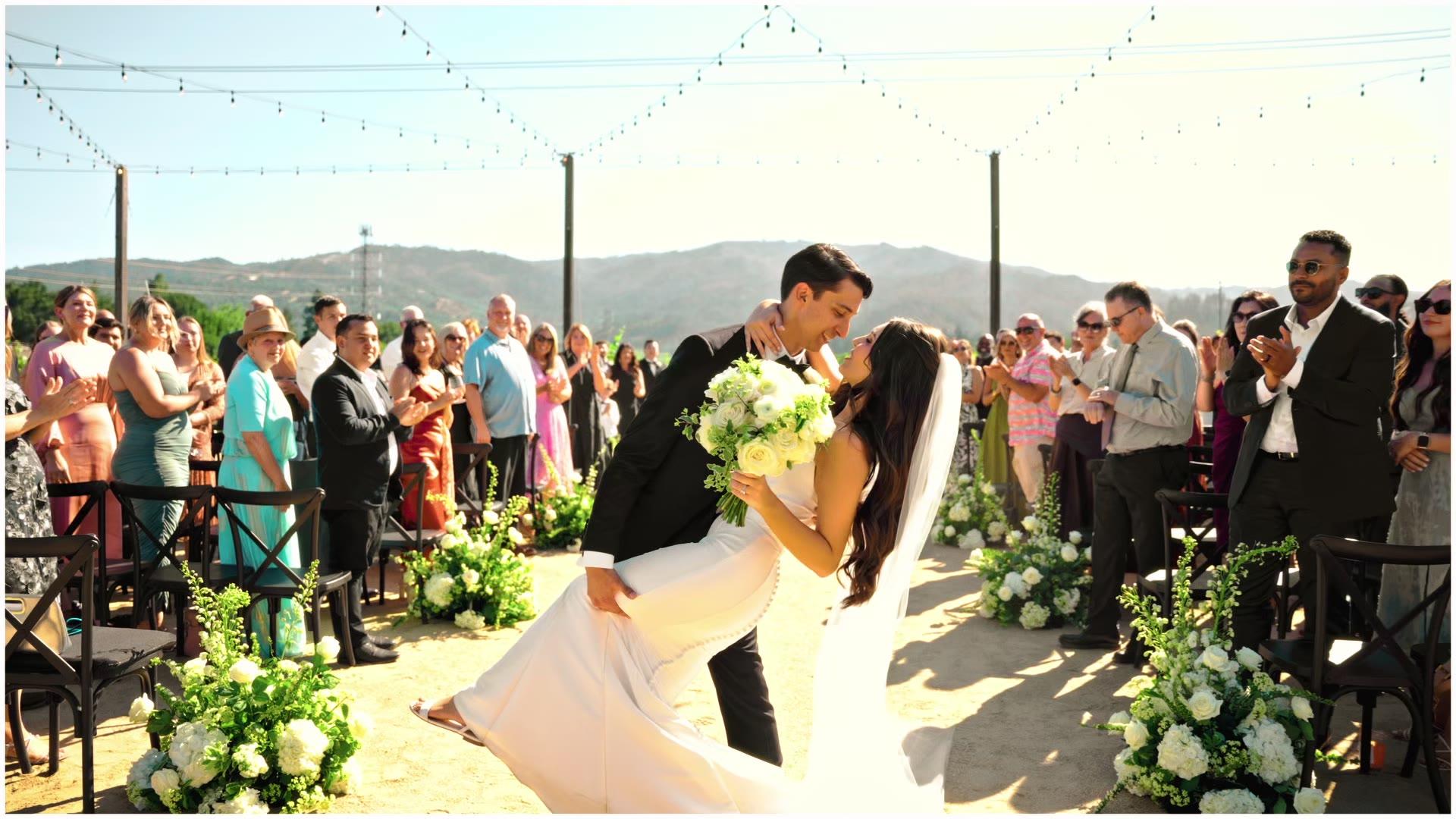
A wedding film is made from one day and meant for a great many evenings after it. It is not a record of everything that happened, in the order it happened. It is closer to the way you will remember the day: a voice catching on a word, the light turning gold across a table, your mother’s laugh from the other side of a room.
This piece is for couples still deciding whether to have a film at all. It sets out what we mean by the word, how a film differs from a recap, and what we believe makes one worth watching again in twenty years. The facts come from the sources listed at the end; the beliefs are ours, and they are the same ones behind how we work.
A film, a recap, and the difference.
The trade has never settled on its names. The same finished piece can be called a wedding film, a wedding movie or several other things, and the words are used loosely. Two broad ways of working do stand apart. One is documentary: the day is edited in the order it happened, so that it unfolds as it did. The other is usually called cinematic, and in its common form it leans on slow motion, transitions, saturated color, unusual angles and dramatic music to raise the feeling.
A recap, or highlight reel, is a short cut of the day’s best-known moments: the vows, the toasts, the first dance, the cake. There is no standard length for one, and phones and Instagram have pushed many of them shorter still. A recap is useful. It is made to be shared the week after, and it does that well.
When we say film, we mean something else: a piece made for memory rather than for the feed, built on the words that were spoken, shaped by the light, cut with restraint, and meant to be watched again by the two of you long after anyone else has stopped asking to see it.
- A recap moves through the day’s moments quickly, in order, under a song.
- A film follows what the day felt like, and lets the people in it speak.
Not the order of the day, but the shape of it.
Memory does not keep a timeline. Since Frederic Bartlett’s early studies, psychologists have understood remembering as a reconstruction, shaped by what we perceived, what we imagine and what we already know.
Later work by Daniel Kahneman and his colleagues found something more particular. We judge a past experience mostly by how it felt at its most intense moment and at its end, and we largely ignore how long it lasted. It is called the peak–end rule.
A film that follows memory takes this seriously. It does not give the cocktail hour the same weight as the vows because both lasted half an hour. It may open in the evening and return to the morning; it may lay your father’s toast over the walk the two of you took alone at dusk. The order is the order of feeling.
The film editor Walter Murch, who cut The Conversation and Apocalypse Now, proposed in In the Blink of an Eye a ranking for deciding where to cut: emotion first, by a wide margin, then story, then rhythm, with continuity, whether one shot matches the next, near the bottom. We edit a wedding in much the same order.
One more finding is worth knowing, though it is about the people holding a camera rather than the people in front of it. In a museum study, visitors who photographed objects remembered fewer of them, and fewer of their details, than visitors who only looked, and later studies have found the same. We take it as a quiet argument for letting one person watch the day carefully, so that the two of you, and your guests, can simply be in it.
Half of what you feel, you hear.
George Lucas, who says that he and Walter Murch made sound a focus from their days at film school, put it plainly in an interview with Mix: “I feel that sound is half the experience.” We believe sound is half the emotion of a wedding film, and often more.
Many of the home movies families keep from the 1960s and early 1970s are silent. Super 8, which Kodak introduced in 1965, began as a silent format; cartridges that recorded sound in step with the picture arrived only in 1973, and a cartridge held just a few minutes of film. Watch one now and you see faces you love saying words you will never hear.
Cinema itself was reshaped by sound. Once sound arrived, in the late 1920s, projection speeds could no longer drift, because the ear notices a change in speed more readily than the eye. The twenty-four frames a second that still give film its look are, in part, a gift of sound.
So the spine of a film is its words. The vows, in your own voices. The toasts, heard whole before we choose a line from them. A grandmother’s blessing, a friend’s joke that makes sense to six people. We place small wireless microphones on the couple and the officiant, and we build the film around what was said, rather than laying a song over the top of the day.
Music matters too, in its place. A brain-imaging study published in 2009 found a region of the brain, the medial prefrontal cortex, linking familiar music to strong personal memories. The song you danced to will carry you back on its own. That is why we use music sparingly, and never over the words that matter.
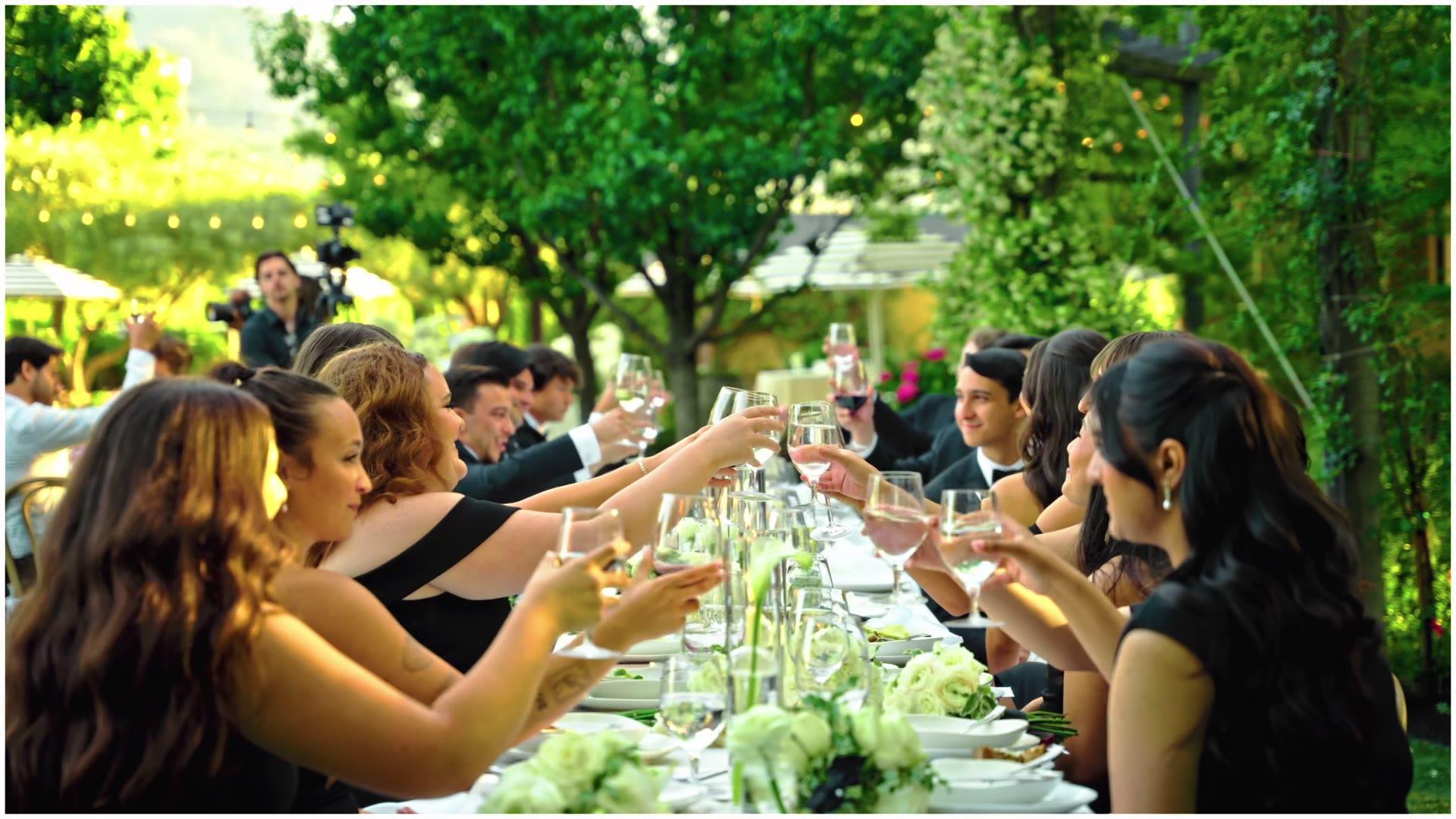
Quiet, on purpose.
The familiar tools of the cinematic style, slow motion, showy transitions, saturated color, a swelling score, are made to raise feeling quickly. They work for a minute. Over twenty years they date, the way a particular filter dates a photograph, and they put the filmmaker’s hand between you and your own day.
In the same interview Lucas says that “loud is not better.” A film needs room in its range so it can build toward a moment; when everything is loud, the ear tires and the viewer grows agitated. We think the same is true of pictures and pace. If every moment is heightened, none is.
- Real time, mostly. People move at the speed they moved. Slow motion, if at all, for a breath.
- Cuts you do not notice. No spins, flashes or swooshes between shots.
- Silence left in. The pause before a vow, the room going still before a toast.
- Music beneath the picture, never over the voices.
- Color as it was, warmed a little, never pushed.
Restraint is not coldness. It is trust: that a hand finding another hand needs no help from us.
Where the light is the protagonist.
Before any of us arrives, the light has decided how the day will look. When the sun is low, in the hour or so before sunset, its light is redder and softer; more of it comes from the sky, so contrast falls and shadows lengthen. Cinematographers call it magic hour. Midday sun is the opposite: hard highlights, dark shadows under the eyes, squinting through the vows.
Just after sunset comes the blue hour, when the light is mostly blue and there are no sharp shadows at all. It is a tender time in a wedding film: the two of you a little apart from the party, the sky still holding its color.
Neither hour has a fixed length; both change with the season and the latitude. In Napa in 2027, sunset falls near 7:32 in the evening on the first of April, about 8:37 at the end of June, near 7:17 in mid-September and 6:31 in mid-October. There is more on timing a ceremony to it in our notes on building the day around the light.
We plan a film around the light the way a gardener plans around the sun. If we could ask one thing, it would be a ceremony that begins about an hour and a half before sunset, so the vows fall in warm light and the portraits after them in the best of it. A film can be made in any light. It is only kinder in some.
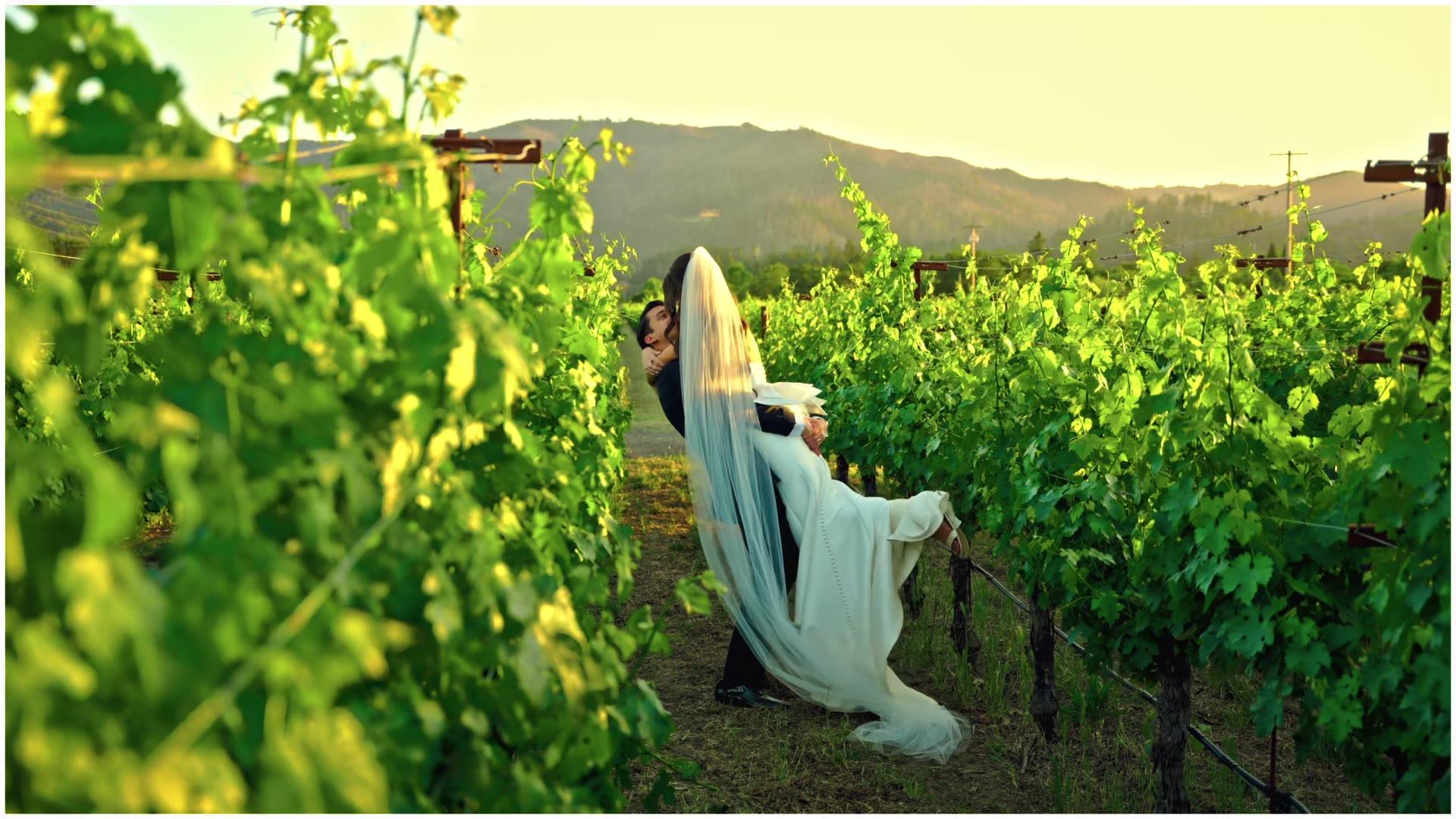
Warm, grainy, and a little imperfect.
Film grain is the random texture of processed film: tiny particles of silver, or clouds of dye, that never fall the same way twice. It is part of why old film seems to breathe. A digital image has no grain of its own and can look sterile to the eye; grain taken from real film can be laid over it to bring back some of that life.
We love a warm, grainy, film-like look, not as nostalgia for its own sake but because we believe it ages well. A picture a little soft at its edges, a little warm in its skin, a little alive in its shadows, does not look like a particular year. It looks like memory.
One practical note. Because grain is random, some streaming formats, AV1 among them, strip it out when a file is encoded and rebuild it when it plays. What you see through a streaming link may not be quite what left the edit, which is one more reason to keep the full file.
We plan a film around the light the way a gardener plans around the sun.
A film for an evening twenty years from now.
The people who carried the family 8mm camera to friends’ and relatives’ weddings were not making something to share that week. They were making something to keep.
Research on nostalgia suggests why such films matter later rather than sooner. Constantine Sedikides, Tim Wildschut and their colleagues describe nostalgia as mostly positive, self-relevant and social: it lifts mood, raises self-esteem and strengthens a sense of connection to others. Their later review finds that nostalgia brought on by music strengthens that connection too.
That is the audience we cut for: not a feed the week after, but the two of you on an ordinary evening in twenty years, perhaps with children who never met some of the people speaking. A recap answers what happened. A film, we hope, answers what was it like, and who were we.
A film can only be watched again if it survives. The Library of Congress gives plain advice for personal files:
- Keep the highest-quality version you have; the file’s quality matters.
- Keep at least two copies, stored as far apart as is practical.
- Check them at least once a year, and make new copies every five years, or sooner if needed.
No one can promise how long any format or platform will last, and we will not. A link is a convenience; the file is the film.
What to ask before you decide.
If you are weighing whether to have a film at all, or choosing who will make it, these are the questions we would sit with:
- Will we want to hear our vows again, in our own voices, in twenty years?
- Is there someone whose voice we would give anything to keep: a grandparent, a parent, a friend?
- Do we want something to share the week after, something to keep for decades, or both?
- When we watch a filmmaker’s work, do we hear the people speak, or mostly a song?
- Does the editing follow the clock, or what the day felt like?
- Is the look made to impress now, or to age well?
- Will we receive the full-quality file, not only a link?
And one for the planning: what time is sunset on our date, and where will we be standing an hour and a half before it?
If you are deciding now whether to have a film at all, we are glad to talk it through with you, whether or not we film your day.
We’d be honored
to film your day.
If our work resonates, we would love to hear about your day.
Begin the conversation